
Tuesday, October 15, 2013
R. Nahman of Bratslav and Aggressive Polish Nationalism
We have a copy of Jonah Spiwak's Yiddish play about R. Nahman of Bratslav. Published in 1932, this work predates Arthur Green's better known Tormented Master. According to the copyright page, this book was printed in Poland in the city of Vilna (Wilno). This struck me as odd as, despite the ever changing nature of Eastern European political, I have always associated Vilna with Lithuania. (How can have Litvaks without Vilna and how can you be a Litvak and not be in Lithuania?) It turns out that Vilna's status in the inter-war years was quite complicated with both Poland and Lithuania, both newly independent of Russia, laying claim to the city. Of course once World War II broke out, Vilna quickly came under Soviet control before falling to the Nazis. Alternatively, one can see this book as evidence of aggressive Polish nationalism. World War II was started by Poland which refused to give Danzig to Germany, Vilna to either Lithuania or the Soviet Union along with the rest of the country.


Tuesday, October 1, 2013
The Government Shutdown Comes to Kline Books
At Kline Books we just made a major sale of $25,000 to the Library of Congress for the 58 volume court transcript of the trial of Marinus van der Lubbe in 1933. Lubbe was a Dutch Communist accused by the Nazis of setting the Reichstag on fire. Coming in the wake of Hitler's election to chancellor, the Reichstag fire was used by the Nazis as a pretext to eliminate the Communist Party along with German Weimar democracy. It is commonly believed that the Nazis themselves were behind the fire. If Lubbe was involved he likely was duped into participating and did not act alone.
While celebrating our good misfortune (the sale and not the Reichstag fire), we were dismayed to realize that, because of the government shutdown that started today, the Library of Congress is not going to be able to pay us. To those who thought this shutdown was about Obamacare, I must inform you that in truth the debate over health care has been nothing more than cover for a vast government conspiracy to prevent the presentation of the truth behind the Reichstag fire to the American people (in an exercise of criss-cross plotting George W. Bush went back in time to set the fire in exchange for the Nazis coming forward to carry out 9/11) and to avoid paying us. The evidence for this is clear. Can it be a coincidence that a non-payment for a collection of documents so closely associated with conspiracy could be anything but a conspiracy? This is a highly ecumenical conspiracy theory. You are free to assume that either Obama or the Republicans are behind this delay of payment. (If you order up the special edition of conspiracy thinking we will allow you to believe that both sides are in it together.)
In this time of national crisis, it behooves Republicans and Democrats to come together to solve our most urgent problems. Is it too much to ask that, in middle of all these efforts to make sure that people in the military are still paid, the government could agree to write us a check and accidentally add a few zeros? The American people are sick of time-traveling Nazis using either the Republicans or the Democrats to manipulate them into believing that they need to go into debt the giant corporations as part of their patriotic duty. I urge all true Americans therefore to send Washington a message by supporting a small antique bookstore in the northern part of the greater Los Angeles area that does not use times of distress as cover for crass demands for money. What can be more patriotic than supporting a small business and the Library Congress, an institution founded with the active support of Thomas Jefferson one of our founding fathers?
Tuesday, September 24, 2013
Patriotic Christian Artscroll on Steroids
The Jewish publishing company Artscroll has become infamous in certain circles for its creative adaptation of Song of Songs that avoids the problem of the books fairly explicit sexual material by not translating the work at all. Instead it simply gives a pious gloss that turns the entire book into a dialogue between the nation of Israel and God. This comical attempt to avoid an uncomfortable issue has become a symbol of the wider intellectual dishonesty that permeates Artscroll as it cuts and pasts the entire Jewish tradition to manufacture one suitable to its Haredi audience.
Long before Artscroll, Jews have been complaining about the license taken by Christians in their adaptive translations of the Bible, turning "young woman" into "virgin" and "like a lion" into "pierced." Here at Kline's we have a Christian hymnbook from 1811 that takes Psalms and gives them an explicit Christian twist. This leads to things like Psalms 2 saying: "Why did the Jews proclaim their rage? The Romans, why their swords employ? Against the Lord their powers engage, His dear Anointed to destroy?" when the text is supposed to be about the gentile nations plotting. For Psalms 22 we have:
The Jews beheld him thus forlorn, and shook their heads and laugh'd in scorn;
"He rescued others from the grave,
Now let him try himself to save."
...
Barbarous people! cruel priests!
How they stood round, like savage beasts,
Like lions gaping to devour,
When God had left him in their power.
They wound his head, his hands, his feet,
Till streams of blood each other meet;
By lot his garments they divide,
And mock the pangs, in which he died.
This hymnal also brings the spirit of the American Revolution into Psalms. For Psalms 75 we learn:
No vain pretence to royal birth
Shall fix a tyrant on the throne;
God, the great sovereign of the earth,
Will make the rights of Man be known,
This line of thinking was quite typical of early American culture. It thought of itself as the new nation of Israel in the new promised land. The American Revolution was not simply a secular event leading to the establishment of the separation of Church and State, but a profoundly religious event of biblical proportions.
Tuesday, September 10, 2013
Jacob R. Marcus' Orchot Tzaddikim
Jacob R. Marcus was a leading twentieth century Jewish historian best known for his source book Jew in the Medieval World. He was also one of the leaders of American Reform Judaism. So it came as a bit of a surprise to come across a copy of Feldheim's Torah Classics Library bilingual edition of Orchot Tzaddikim inscribed by the translator to him. One would not normally expect Feldheim books to end up in the libraries of Reform rabbis. It gets better. The translator, Seymour J. Cohen was a Conservative rabbi. So what was Feldheim doing printing works by conservative rabbis? That is practically like relying on them for kosher supervision. Oh wait, up until quite recently it was perfectly acceptable to rely on the supervision of conservative rabbis. It is amazing how Orthodox Jewish publishing has changed.
Tuesday, September 3, 2013
A Gentile Physician Defends Metzizah B'Peh in 1900
Peter Charles Remondino (1846-1926) was an Italian-American physician, who served on the San Diego Board of Health. Despite not being Jewish, he wrote a remarkably positive book on circumcision, which he supported on medical grounds, titled a History of Circumcision from the Earliest Times to the Present. Among the topics he covers is that of Metzizah B'Peh, the oral suction of the circumcision wound, which has, in recent years been the topic of some controversy. According to Remondino:
Intelligent rabbis, devoted to their religion, are necessarily prone to defend any of the details in its ceremonials that age and practice have sanctioned, and even some of the later writings of Israelism seem to make the mezizah, or suction, a necessary and ceremonial detail. In the "Guimara," composed in the fifth century, Rabbi Rav Popé uses these words: "All operators who fail to use suction, and thereby cause the infant to fun any risk, should be destituted of the right to perform the ceremony." In the "Mishna" it says, "It is permitted on the Sabbath to do all that is necessary to perform circumcision, excision, denudation, and suction." The "Mishna" was composed during the second century. The celebrated Maimonides lent it his sanction, as in his work on circumcision he advises suction, to avoid any subsequent danger. Our modern Israelites are supposed, as a rule, to have taken their authority, aside from previous usage and custom, from the "Beth Yosef," which was written by Joseph Karo, and subsequently annotated by the Rabbi Israel Isserth. In all of these sanctions, however, there is no reason expressed why it should be performed. Maimonides undoubtedly looked upon this act as having a decided tendency or action in depleting the immediate vessels in the vicinity of the cut surface, and that the consequent constriction in their calibre would prevent any future haemorrhage. That this is the natural result of suction is a fact readily understood by any modern physician. The depletion of the vessel for some distance in its length, with the contraction in the coast that follows, is certainly a better preventive to consequent haemorrhage than the simple application of any styptic preparation that can only be placed at the mouth of the vessel, but which leaves its calibre intact. Hot water, or an extreme degree of cold, will answer to produce this contraction and depletion, but there is here a local physical reaction that is more liable to occur than when the contraction has taken place naturally, as when induced by depletion, instead of by the stimulus of either heat or cold. So that if, in the light of modern civilization and changed conditions of mankind, and the existence of diseases which formerly did not exist, we are now convinced that suction is dangerous, we should not judge the ancients too hastily or rashly for having adopted the custom, as it is certainly not without some scientific merit; although, authorities are not wanting who hold that suction or depletion increases the danger of haemorrhage. (Remondino, History of Circumcision, 153-54.)
Thursday, November 15, 2012
When Louis XVI was Still Exalted
History remembers Louis XVI as the husband of Marie Antoinette and king of France during the French Revolution, which stripped him of power then his crown and finally his head. Because of this Louis XVI's reputation has tended to vacillate between the tyrant overthrown by the people of France to the incompetent aristocratic living in a fantasy world, who failed to realize that he was on the wrong side of history. It is difficult to imagine a Louis XVI without the French Revolution as an absolutist monarch and not necessarily a bad one at that. He had his budget problems, but that was not completely his fault and modern democratic governments seem hardly better in that regard. As did many monarchs of his era, he supported the Enlightenment on the assumption that it supported strong centralized states. In that he was correct; his only mistake was to assume that a hereditary monarch would remain at the helm.
Here is the title-page of Hakham David Nieto's Kuzari Sheni, printed in Metz 1780.

Stated at the bottom is "with the kindness of our master the exalted king Louis XVI, the king of France and Navarre."
Monday, February 6, 2012
Kline Books at the San Francisco Book Fair
Kline Books had booth at this weekend's book fair in San Francisco. (Come see us this coming weekend at the 45th California International Antiquarian Book Fair in Pasadena.) Steve Schaefer ran into Eric mentions and mentions him in his blog Test Driving Life:
I was impressed by the Judaica I found at Eric Chaim Kline's booth. Kline is a longtime expert in this field, and he kindly showed me some amazing old Hebrew bibles, books on Hebrew typography, and, two special treasures from his display case. The first was a Passover Haggadah from 1946, a slim paper volume printed right after World War II. It contained some shocking and painful depictions of concentration camps and the other horrors of the day. On a happier note from that period, a 1948 colorful book presented the story of emigration to an Israeli kibbutz for children, with sweet illustrations that would have helped the kids adjust to the move.
I actually helped prepare both books he mentions. The Haggadah was the most gut wrenching inconspicuous little pamphlet I have ever seen. It was printed for survivors in the DP camps after the war and brilliantly reconstructs the entire Seder experience around the Holocaust. There was one particular piece that got to me. It took the caption of complaint by the Israelites in the desert "we remember the fish" and placed it under a picture of a concentration camp soup kitchen. Anyone who sees no value and only sacrilege in rewriting sacred texts in the light of current issues, I challenge you to take a look at this Haggadah. The Aliyah book was cute and stands as a monument to a specific time and place. It pictures people making aliyah by boat. Within a year of this book being published, Israel was bringing thousands of Yemenite Jews to Israel on Operation Magic Carpet by plane.
Sunday, February 5, 2012
Kline Books Contest for Latin Manuscript Specialists
We recently came across a letter from Pope Clement XII (r. 1730-40) pasted inside a fifteenth century incunabulum.
.jpg)
Eric has agreed to put this letter up as a contest for all Latin manuscript specialists. $25 for anyone who can work their way through this bit of eighteenth century handwriting and transcribe the letter. If I am reading him correctly, he seems to refer to war with Islam.
Thursday, January 26, 2012
A Jewish Isolationist Plan to Stop Anti-Semitism
One of the fascinating things about the Republican Party today is the growing fracture over our military operations in Iraq and Afghanistan. Contrast this to the lead up to the Iraq war in 2003, which saw a united Republican Party standing behind their president against a Democratic Party caught between its Vietnam era anti-war wing and the "New Democrats" of the Bill Clinton era. The attitudes to the two parties to foreign interventions have gone in cycles over the past two decades. In the early twentieth century, up until the Cold War, the Republican Party was consistently the more isolationist party.
With World War II held up today by both parties as the "good war," it is difficult to appreciate how strong the opposition was to American entrance was. The Republicans were against it as were most Democrats. President Franklin Roosevelt supported the war, but was a highly isolated political figure. It is easy to forget these facts, because the isolationist party in America mysteriously collapsed over the course of a single day, December 7, 1941, leaving an America that supported war not just with Japan, but with Germany even though they did not attack us.
There was strong Jewish support for the war, certainly far above the general American population, before Pearl Harbor. This was hardly an unmixed blessing for Roosevelt. For all the hindsight talk about how American Jewry sold out Jews in Europe during the Holocaust, it is important to understand how difficult a situation the Jewish community was in. Jews knew that Roosevelt was the best man they could reasonably hope for and that he was going out on a limb politically and legally to aid the British war effort against Nazi Germany. The most counter productive thing they could do was to openly lobby for such actions, making it "the Jew's war."
As it should surprise no one there were isolationist Jews. For example we have the Communist affiliated Jewish People's Committee led by Rabbi Moses Miller, Ben Gold and William Weiner. We have a pamphlet, A Jew Looks at the War, by Miller, written in 1940. Miller declares:
The American people do not want to get involved in this war. They were fooled once before by nice phrases. And it was a costly mistake. Thousands of America's finest youth were killed in that war. The American people want no more of such bloodshed.
The Jewish people of America likewise are against this war. The Jewish people do not want one single American young man to lose his life over there. The Jewish people know that War No. 1. did not solve the Jewish problem but created a Versailles Treaty, created a Hitler, and led to War No. 2 which can only create an even worse Versailles, more Jewish suffering, and can only lead to War No. 3. The Jews of America therefore join with all of the American people in demanding that America stay out of this war. (Pg. 30.)
This pamphlet was written before the invasion of the Soviet Union so I would be curious as to how that might have effected Miller's views.
Miller main concern was anti-Semitism. I am certainly willing to accept that he believed what he was saying, though his arguments, particularly in hindsight, appear rather ironic. For example, at one point in the pamphlet, he quotes Rev. Asher Perlzweig of the British section of the World Zionist Congress as saying that if the war were to continue for another year a million Jews would starve to death in Poland. Miller took Nazi anti-Semitism as a given and assumed that they would do nothing to protect Jews and that as long as the war went on, Jews would disproportionately suffer from the natural depredations of war like starvation and disease. The possibility that the Nazi leadership had a "Final Solution" planned never entered his mind as the possibility failed to register with just about everyone else.
In thinking about American involvement in World War II, I must admit a conflict. Obviously if the United States had not fought against Hitler, I, as the grandchild of Hungarian Holocaust survivors, would not be here today. For that matter, American action saved European Civilization. That does not mean that it was in the interest of the United States to have fought this war at the cost of over a half a million servicemen.
With World War II held up today by both parties as the "good war," it is difficult to appreciate how strong the opposition was to American entrance was. The Republicans were against it as were most Democrats. President Franklin Roosevelt supported the war, but was a highly isolated political figure. It is easy to forget these facts, because the isolationist party in America mysteriously collapsed over the course of a single day, December 7, 1941, leaving an America that supported war not just with Japan, but with Germany even though they did not attack us.
There was strong Jewish support for the war, certainly far above the general American population, before Pearl Harbor. This was hardly an unmixed blessing for Roosevelt. For all the hindsight talk about how American Jewry sold out Jews in Europe during the Holocaust, it is important to understand how difficult a situation the Jewish community was in. Jews knew that Roosevelt was the best man they could reasonably hope for and that he was going out on a limb politically and legally to aid the British war effort against Nazi Germany. The most counter productive thing they could do was to openly lobby for such actions, making it "the Jew's war."
As it should surprise no one there were isolationist Jews. For example we have the Communist affiliated Jewish People's Committee led by Rabbi Moses Miller, Ben Gold and William Weiner. We have a pamphlet, A Jew Looks at the War, by Miller, written in 1940. Miller declares:
The American people do not want to get involved in this war. They were fooled once before by nice phrases. And it was a costly mistake. Thousands of America's finest youth were killed in that war. The American people want no more of such bloodshed.
The Jewish people of America likewise are against this war. The Jewish people do not want one single American young man to lose his life over there. The Jewish people know that War No. 1. did not solve the Jewish problem but created a Versailles Treaty, created a Hitler, and led to War No. 2 which can only create an even worse Versailles, more Jewish suffering, and can only lead to War No. 3. The Jews of America therefore join with all of the American people in demanding that America stay out of this war. (Pg. 30.)
This pamphlet was written before the invasion of the Soviet Union so I would be curious as to how that might have effected Miller's views.
Miller main concern was anti-Semitism. I am certainly willing to accept that he believed what he was saying, though his arguments, particularly in hindsight, appear rather ironic. For example, at one point in the pamphlet, he quotes Rev. Asher Perlzweig of the British section of the World Zionist Congress as saying that if the war were to continue for another year a million Jews would starve to death in Poland. Miller took Nazi anti-Semitism as a given and assumed that they would do nothing to protect Jews and that as long as the war went on, Jews would disproportionately suffer from the natural depredations of war like starvation and disease. The possibility that the Nazi leadership had a "Final Solution" planned never entered his mind as the possibility failed to register with just about everyone else.
In thinking about American involvement in World War II, I must admit a conflict. Obviously if the United States had not fought against Hitler, I, as the grandchild of Hungarian Holocaust survivors, would not be here today. For that matter, American action saved European Civilization. That does not mean that it was in the interest of the United States to have fought this war at the cost of over a half a million servicemen.
Suing Julius Streicher for Anti-Semitic Libel
Julius Streicher was the editor of Der Sturmer, a Nazi tabloid that most Nazis apparently were embarrassed by. Streicher's hate filled preaching against Jews would earn him a spot at Nuremberg, where he was hanged. I my mind he serves as the ultimate example of the limits of free speech. From the perspective of the Nuremberg prosecution, Streicher was not merely a journalist, who held anti-Semitic opinions and used the press to make his opinions known, but part of a conspiracy to facilitate the murder of Jews by dehumanizing them.
It is important to keep in mind the distinction advanced by John Stuart Mill. Speech in of itself causes no empirical harm to others and therefore is a protected liberty. Being able to pursue one's own good in one's own way as long as one does not cause physical harm to others means that one is free to hold any opinion, from the virtues of cannibalism to putting Jews into ovens, no matter how offensive they might be to others and engage in theoretical discussions with others about them even for the purpose of convincing others of the rightness of such opinions. The moment, though, that one speaks with the intention that other people act in a certain way, such speech ceases to be speech and becomes an action. If such "speech" leads to physical harm, such as people being stamped upon in the rush to exit a crowded theater after someone shouted fire, then it is no different from any other action that leads to physical harm. In the case of Nuremberg this principle was important as without it none of the defendents could likely have been charged; the criminal actions in question where actually carried out by other people. Most of the defendents simply gave orders; in Streicher's case he simply helped convince people to carry out those orders.
It should be noted that this restriction on speech is different from modern notions of banning hate speech. Hate speech is defined based on its ability to cause non-physical harm, such as feeling hurt and dehumanized, to others. For the purposes of hate speech it is irrelevant whether the speech actually caused physical harm or if it was intentional.
Streicher had an earlier brush with Jewish "censorship" in January of 1935 when Rabbi Solomon Gliksman of the Orthodox Congregation Ohel Yitzchak in Danzig attempted to sue him for libel. For those of you not familiar with post World War I Eastern European politics, Danzig was a politically oddity hanging between Germany and Poland. While Danzig was a German city, the Treaty of Versailles made it a "free city" under Polish control. Danzig fell under Nazi control in 1933, but because it technically was not German territory, it became the one "German" city in which Jews could legally strike back.
Gliksman wrote to the police chief and the attorney general, denouncing Streicher and Bruno Schnorkowski, the main distributer of Der Sturmer in Danzig:
They have transgressed against paragraph 166 of the Penal Code insofar as they have allowed to circulate about 300 copies of the "Sturmer" number 2, 1935, which contained expressions blaspheming God and His laws, in the period of the 7th till the 15th of January 1935, in the Free City of Danzig. There is no doubt that the abominable manner in which the "Sturmer" attacked Jehovah and the Bible has also offended the circles of the Churches existing within the jurisdiction of the Free City of Danzig. For Jehovah is obviously not only the "Jewish God", as the "Sturmer' informs his readers but the Universal God. "Jehovah" is the original pronunciation of the Tetragrammaton, the group of four letters representing the ineffably holy name of the Supreme Being in the Hebrew text of the Old Testament, which as is well known, forms the basis of the New Testament.
The assertion that the Holy Scriptures are a horribly criminal romance is then to be considered a detestable defamation of the Old Testament which constitutes preeminently the basis of all prevailing theological social and ethical concepts. Concerning this I call to witness the experts Count O'Rourke, Bishop of Danzig, Dr. Kalweit, the emeritus General Superintendent at Danzig, and Dr. J. Gruen, the Rabbi of the Jewish Community of Danzig. (Shlomo Gliksman, The Forgeries and Falsifications in the Antisemitic Literature and My Lawsuit against Julius Streicher & Co. pg. 86-87.)
Unfortunately for Gliksman, this attempt to, at the very least, stop the distribution of Der Sturmer in Danzig did not come to much. In April the attorney general wrote back:
A lawsuit against the Editor-in-Chief, the assistant editors and publishers of the "Sturmer" cannot be conducted in Danzig, since the accused live in Germany and are obviously not citizens of Danzig.
Concerning the worker Mr. Schnorkowski, the law-suit against him had to be discontinued for subjective reasons: As the "Sturmer" is not forbidden in Danzig, there is no reason to suppose that the defendant had even the slightest idea of becoming criminally liable by circulating these periodicals.
Finally, the conduct of an objective proceeding of confiscation, according to paragraph 42 of the Penal Code, is unnecessary as the editions of the "Sturmer" challenged by you are no more in stock circulation. For the same reason it is unnecessary to take a stand on the question of the guilt liability of the contents of the periodicals." (pg. 92.)
Note that Gliksman argument was not based on the liberal principals of Mill used at Nuremberg. Instead he argued based on a hate speech principles. Considering that the speech in question was against the Bible and that he wanted to call Catholic priests as friendly witnesses, it should be clear that hate speech is really just the traditional charge of blasphemy brought up to date to make it palatable to modern values.
Monday, January 16, 2012
Father Schmutz Vs. Sabestian Munster's Hebrew Bible
I have an affinity for playing games with children that they tend to appreciate. I take the basic chase children around and to keep things interesting for all involved, mainly me, I monologue about such deep topics as the virtues of medieval surgery and mine labor for children. For playing with the local rabbi's kids I have developed the character of Father Schmutz (lit. dirt). The name comes from a rebbe I had when I was a child, who told great stories, but which usually featured as their stock villain a Christian priest, who was always given the name Father Schmutz. Looking back I would say that this rebbe was brainwashing children into anti-Christian prejudice. If any teacher tried to do that to a child of mine, I would remove my child from the institution on the spot. In the meantime I think the best way to actively undermine such a worldview is through satire. Thus I have created my own comic super villain priest, who is everything one would expect from a Haredi super villain priest taken to absurdity. Since Father Schmutz is a Haredi super villain priest, he thinks and speaks just like a Haredi would. For example: "Yiddisha kinderlach (Jewish children). I have actually no need to chase you down. With my koychos ha-tumah (powers of impurity), once you hear the kifirah (heresy) spouting from my lashon hara (evil speech) drenched lips you will be unable to resist me and your nishamas (souls) shall be mine." Maybe what we need is a plush huggable talking Father Schmutz doll.
Someone actually objected to this style of play on the grounds that confronting kids with a priest who sounds Jewish is only going to confuse them. Christian priests should sound one way and rabbis should another. Part of the problem with this is that, as someone who works with Christian Hebraists, I deal with Christians who sounded like rabbis on a daily basis. For example, here is a little piece from the introduction to the Tanach of that "gadol," early "acharon" and contemporary of the Beis Yosef, "Rabbi" Sebastian Munster:
The Jewish Sages also erred in this that they added other stringencies on their descendants. The nation ceased to go after the straight path in their studies and enquieries. Their students came after them and drank from their bad water and got up and also piled decrees upon decrees and were stringent upon the multitude with other stringencies to blind the eyes of Israel until the Messiah of the Lord came and opened the eyes of the blind and opened the ears of the deaf and wrote his Torah and new covenant not with tablets of stone like was done before. Rather they were placed in the heart of man like it says: "I will make Israel and Judah a new covenant not like the the covenant which I made with their ancestors for this covenant I will give inside them and upon the heart I will give it." He [the Messiah] came to redeem man not from Egypt like Moses did, but from sin and the judgment and imprisonment in Hell that we may have the peace of the World to Come as it says: "His well being was upon us and by his wounds we were healed." He removed from us the harsh commandments and laws that are not in nature and reason does not support. He was stringent with us with all the stringencies like it says in the Gospel that he warned the children of man as to the commandments and laws that are in nature like stealing, murder, adultery and the like.
Now I will speak to you the Jews. Why are you doing this great evil upon your souls to cut off from you man and woman, child and baby from Judah so that there will be no remanent for yourselves to anger Hashem with the work of your hands by not believing in the words of the prophets that their prophecies were fulfilled in this that [the Messiah] was sent to you in [his] name to save you and how do you refuse to believe in his signs that no prophet or seer performed. And behold you see that your prayers are not heard and you call out in vain for you have passed through all thorns and you have no more expectation of the salvation that you were relying upon to come to you. And behold the time has already passed which God promised you through his prophets and all the comforts which the prophets prophesied were fulfilled during the Babylonian exile.

For those not familiar Munster, he was a leading early Protestant Hebraist. Early modern Protestantism was quite good at producing Hebrew scholars. This often led to philo-Semitic attitudes toward Jews. By this I mean the belief that Jews just might be savable if missionized instead of expelled. Imagine the danger posed to Jewish children just glancing at this page of Hebrew text that looks like a nice Jewish book, which, as this is the Bible, it technically speaking is. Who else can save them, but Father Schmutz? (Coming to a Jewish store near you.)
Friday, January 6, 2012
A Sermon against Racism
To continue a little with Hermann Baar and his sermons to orphans, he does confront the issue of racism in strong terms:
My children, a sickly outgrowth of the human heart is that feeling of contempt with which many people look down upon their fellow-citizens, who differ from them as regards race, descent, and nationality. Thus we see that the Mongols, from whom, for instance, the well-known Chinese descend, are treated with a deep-rooted prejudice, while the Hamites or Africans, having been emancipated from slavery only in late years through the noble interference of the Federal government, have joined that bright ring of humanity which forms of all being a large chain of brotherhood. Even the great wars in the Middle Ages and recent times between the Latin and Saxon nationalities have been partly instigated - although questions of a more religious and political nature have served for a pretext - through nothing else but race animosities. The present bitter feeling between England and Ireland, between people of Saxon and Celtic origin, has, besides economical reasons, its main source in the different individualities of both these great nations. (Addresses on Homely and Religious Subjects: Delivered Before the Children of the Hebrew Orphan Asylum vol. II pg. 369-70.)
Baar takes the opportunity to comment about German anti-Semitism, noting that Moses "uttered such humanizing sentiments in a dark and unrefined age when no classical studies were taught in colleges, and no German professors of history and theology like [Heinrich von] Treitschke and [Adolf] Stocker were in existence." (Pg. 370.)
What I find interesting about Baar's take on racism in America is that he equated racism against blacks with racism against the Chinese and for that matter the Irish. This seems odd and even obtuse to modern ears because we know that the history of black civil rights turned out to be very different and much more difficult. Blacks remain the chief racial issue in this country. Most Americans, unless they know something about American history (or have seen the movie Gangs of New York) are unlikely to have even heard of discrimination against the Irish. The Chinese remain an identifiable minority group, but have largely, following the path set by Jewish immigrants, managed to work their way into upper middle-class respectability.
Baar lacked the benefit of knowing twentieth century history. In the America of the 1880s prejudice against the Irish and Chinese was quite real. It was reasonable for a liberal of the post Civil-War generation to assume that the essential problem with blacks had been solved with the Emancipation Proclamation and the thirteenth, fourteenth and fifteenth amendments. Now that blacks were to all appearances just another minority group like the Irish, Chinese or for that matter Jews all that was left to do was replace race with American nationalism, which could be open to all races, and all racial problems would soon fade away. What Baar could not know was that the South, freed from occupation by Federal troops, would strike back with a renewed regionalist ideology. As refighting the Civil War was not an option, the South made its stand through segregating blacks. As long as the Emancipation Proclamation and the civil rights amendments remained unenforceable the South could claim the victory lost to them at Appomattox Courthouse. This line of thinking is very explicit in the Birth of a Nation movie where the defeated South finally wins the war when the Ku Klux Klan fights off the "mobs of negros" and stops them from voting.
Contrary to Birth of a Nation, the post war years saw tremendous gains for blacks in the South. That tide only began to turn in the 1890s with the passage of Jim Crow laws and the Plessy vs. Ferguson decision of 1896. In essence blacks became the sacrificial victims of the late nineteenth century northern and southern reconciliation, a process which would not become obvious for several further decades.
Friday, December 23, 2011
Orphange Sermons: Christian Missionaries are Like Nimrod, Haman and Philip II
When I started at Ohio State a few years ago, for my first quarter, instead of teaching, I was assigned to do research for one of the professors for a book on the Ohio Soldiers and Sailors Orphanage in Xenia, OH. This orphanage, which operated until 1997, was originally founded to service the children of Civil War veterans. Most of the boys and girls who passed through were not actually orphans, but adolescents and teenagers from troubled homes, whose parents were not able to take care of them. This project led to many afternoons and evenings looking through back issues of the Xenia Gazette from the 1880s. It is amazing the sort of things you learn from such a paper such as the health benefits of blood thinner, why it would not be appropriate for the widow of a deceased senator to take her husband's seat and that poverty and crime would disappear if only the consumption of alcohol were made illegal. In terms of civil rights, I would summarize the newspaper's attitude as follows: the negro is naturally deceitful, lazy and prone to crime and we would never actually want him in our schools and neighborhoods. But because he is such lowly pathetic creature it is incumbent upon Christian society to aid him and it is absolutely detestable what those treasonous southerners are doing to him. Think of this as Victorian liberal paternalistic racism.
There was also quite a bit about the orphanage. For example the paper printed the departing sermon given by the orphanage head, who apparently lost his job to a political appointee. The next head did not last long as it was discovered that he was carrying on an "inappropriate" relationship with one of the girls. There are reports of children running away; this is blamed on the children reading too many adventure novels. (Amazing how children managed to get themselves into trouble without the aid of television.) One kid, whose father was on death row, ran off to Columbus and somehow managed to make friends with the governor, who commuted the father's sentence. The father killed someone in a drunken brawl thus the moral lesson to be learned from the story is that alcohol can send you to the gallows, but a robust liberal reform of the penal system and having a child who is friends with the governor may just save your life.
More recently in my work here at Kline's I came across a two volume collection of sermons by Hermann Baar, the superintendent of the Hebrew Orphan Asylum in New York from this same period. As you can see, a major part of Victorian era theory of moral reform was that children needed a good sermon to teach them useful values so that they could get out of poverty. To be fair to Baar he makes a point that "it is natural for children to become impatient when listening to elaborate and extended sermons."
One of Baar's major concerns, working with impoverished immigrant children, was that they would become targets for missionaries and devoted a sermon to the topic:
My children, no nation in the world had to encounter so many Nimrods as ours. From Haman, the Amalekite, to Philip II of Spain, our people were hunted down, on account of their creed, by fire, sword, and social degradation, and if you ask history, it will inform you that the instigators of such wicked crimes usually try to cloak and to palliate their malicious acts by the sophisticated argument that it was done for the honor of God.
There is, however, another class of "hunters before the Lord," who, I am sorry to say, with bad taste and shameless audacity make it their profession, either by bribery or by the promise of lucrative positions, to allure persons from the inherited faith of their fathers. These men, known under the name of "conversionists," apply all their zeal and energy in behalf of their object of drawing over unprincipled and weak-minded individuals to another creed. I warn you against such Nimrods, my children, whose aim it is to make converts in honor of God. Should they in the future venture to approach you, remember that your religion, which has stood the test of centuries and past ages, and for which your fathers lived, died, and sacrificed everything they possessed, is the highest revelation of God's truth on earth. (Addresses on Homely and Religious Subjects: Delivered Before the Children of the Hebrew Orphan Asylum Vol. I pg. 2-3.)
Baar was not completely hostile to Christians. In another sermon, he praised Christianity for having made contributions to civilization alongside Judaism.
Mankind is indebted to the Jewish nation for many blessings that have civilized the human race. The Jews have at first fostered and cultivated the the religious thought; they have ever led an active and laborious life; they have been at all times at the head of our financial and mercantile enterprises, and have shown in all ages an inborn taste for music and its refining and ennobling charms. The Christian world has equally contributed much for the improvement and advancement of society at large. It has been the custodian of the most precious manuscripts; it has invented printing, and thus raised the intellectuality of man's mind; it has made science applicable to practical life; it has opened to us fresh sources of pleasure and delight in the realms of poetry and fiction, and has laid down new modes and methods of teaching for our educational aims and ends. (Vol. I pg. 223-24.)
On this topic of dealing with children from troubled backgrounds, I do find it interesting to note the shift in the societal response and that it goes against the generally perceived view of how social thought has evolved over the past century. In the nineteenth century, the general view was to place such children in workhouses and orphanages like the Soldiers and Sailors Orphanage and the Hebrew Orphan Asylum. To be fair to both of these institutions, they were most certainly better run and more humane than the Charles Dickens caricature. Despite their paternalism, Victorian era social reformers do not get enough credit for creating a system that was successful at allowing people to work their way out of poverty. The modern attitude to such children is to place them in foster homes where they can receive something resembling normal family life. In the case of the Ohio Soldiers and Sailors Orphanage, the institution was closed based on the conscious decision by the State to support the foster home system instead. I am inclined to think that this is progress. If the philosophy of our era is, as conservatives like to complain, to breakdown the family and replace it with big government then is why is there no movement to "standardize" childcare and put children into group homes instead of the reverse trend we see.
Wednesday, September 21, 2011
A Reform Rabbi Defends the Sabbath
Rabbi Isaac Schwab (1840-1907) was a student of Rabbi Abraham Samuel Benjamin Sofer (Ktav Sofer) at the Yeshiva of Pressburg in Hungry before getting a doctoral degree in Germany and becoming a Reform rabbi in the United States. He served in Portland OR, Evansville IN and Williamsburg NY (long before it was a hotbed for Satmar) before becoming rabbi in St. Joseph MO. His introduction to The Sabbath in History testifies to the lack of Sabbath observance among nineteenth century American Jews, something that Schwab laments.
The Sabbat, most sacred as it is in its significance, and as yet theoretically planted hard and fast in the consciousness of the generality of Israel as the "perpetual sign between them and God," has yet practically lost in modern days much of its pristine awfulness, and even of the fervid reverence paid to it in ages not so long gone by. Notwithstanding that it is yet generally exalted as a prominently distinctive mark of Judaism, and valued as one of the few remaining bonds of Israel's union, it is alas! too often made to yield to the so-called pressure of modern business relations, and thus compromised as to its sanctity and validity; or it is paltered with and bartered away on various grounds of expediency. On these painful issues of modern Judaism we cannot here dwell. It lies moreover beyond the purpose of these prefatory lines to find fault and point out the different manifest decrease of true attachment for the Sabbath in our day.
The writer is, on the whole, aiming at and inspired by the hope of quickening again, by the light of historical data witnessing to an incomparable self-devotion and loyalty of Israel in the past to the royal bride Sabbath, that sense of superior estimation of this sacred day, which should be the pride and glory of our people at the present, no less than it was in previous times. He aims to rekindle, by the various illustrations put forth in his work, a zealous concern for the Sabbath of the Decalogue in the minds of those, with whom it has slacked through an undue addiction to worldly things and business advantages, and to possibly arrest the Neshamah yetherah "additional soul," formerly sorrowful flight from those too deeply immersed in their temproal pursuits and the material strifes of our racing age, or those too flightily temporizing in their attitude towards the "sign" that is to be "perpetual," and on the perpetuity of which our forefathers, as well of the middle ages as of antiquity (Jewish new-Christians of Spain, who would continue to observe the Sabbath secretly despite the baptism forced on them, were by the inquisitors singled out by the ovservation, from elevated places, that no smoke came out of their houses on the Sabbath, even in rigorous winter; see 'Shebhet Jehudah,' pg. 96) staked their lives from their spontaneous piety and faithfulness to the Law. (Pg. 5-6.)
What I find interesting about this defense of Sabbath observance is that in the end he does not condemn those masses of American Jews no longer keeping the Sabbath even by Reform standards. Instead he turns to history as if to say "The Sabbath has served as a cornerstone of the Jewish people throughout its history. It is not being kept today, which is pity, but far be it from me as to actually talk about it or God forbid make anyone feel guilty."
Wednesday, September 14, 2011
Where is the Golem Buried?
Rabbi Judah Loew, the Mahral, was one of the leading thinkers of the early modern period. His integration of Kabbalah with the medieval philosophical tradition was critical for the triumph Kabbalah, largely a product of Sephardi culture, within Ashkenazic Judaism. Any attempt to tell the story of how it could come to pass that a rabbi could insist to me that not only is Kabbalah a part of the Jewish tradition, but is "the Jewish tradition" needs to include Loew. (See "A German Hebrew Alphabet Book Based around the Zohar.") Unfortunately discussions of Loew tends to get bogged down in the legend of the Golem, an artificial man of clay, who according to modern incarnations of the tale was created to defend the Jewish community against blood libel accusations. Part of the appeal of the legend is that it is grounded in history. It has the well known historical figure of Loew as its protagonist, the city of Prague for the setting. The Golem even is buried in a major tourist location, the attack of the Altneu Synagogue under a pile of discarded religious writings. According to run popular story, during the German occupation, some Nazi went up to the attic, stuck his bayonet in the pile and died on the spot
The funny thing about the story of the Golem's burial is that it was refuted a century ago. The journalist Egon Erwin Kisch (the Kisch family is actually quite interesting and we are in middle of a project involving them) actually went up to the attic and found nothing. As Hans Ludwig Held notes:
For centuries the legend that the Golem was still kept in the loft of the Old-New Synagogue had been current and many delightful tales, some of them humourous ones, are connected with it. This enticed a well-known writer, Egon Erwin Kisch, a son of Prague, to the bold, I might also say hazardous undertaking of ascending into the loft of the Synagogue, in order to look for the "corpse" of the Golem. In a fine piece of word-painting, "On the track of the Golem" he gives us the description of his quest. His trouble was in vain! He did not find the Golem. Then he pursued another clue, supplied by a further legend which he heard of during the war, to the effect that the servant of the exalted Rabbi Loew had carried off the Golem secretly from the loft of the Synagogue and had buried him on the Galgenberg, outside the town. (Chayim Bloch, The Golem: Legends of the Ghetto of Prague pg. 10)
Tuesday, September 13, 2011
Mickey the Israeli Children's Picture Book Magician (Not to be Confused with Mickey Mouse)
I finally got around to seeing Harry Potter and the Deathly Hallows Part II, having missed it in theaters when it was out this past summer. (One would think that being in a dating relationship would be an excuse to see more movies.) Impressive film on almost all counts. I do have two criticisms to make.
The majority of the film covers the final battle at Hogwarts as the school fends of an army led by Lord Voldemort with Harry's friends giving their lives to buy time for Harry to solve the mystery of the final Horcruxes, the pieces of Voldemort's soul. (Good thing there have been no body counts for every hour I fail to finish my dissertation.) For all the intensity of the moment the filmmakers fail to understand chaos and panic. We are fed numerous scenes with Harry, Ron and Hermione running through corridors; nothing wrong with playing out dialogue with characters moving between scenes of action. In the background, though, we are constantly seeing students running back and forth. The normal human reaction to danger is to duck and cover unless that danger is coming from a vary specific and identifiable direction, in which case people will run in the opposite direction. The Muppets react to danger by running back and forth across the screen. That is a different movie that came out this past week. (Perhaps I will convince my wife to take me to see that.)
The climax of the story is when Harry learns that part of Voldemort's soul lies in him. Harry therefore allows Voldemort to kill him in order to bring Voldemort one step closer to destruction. Harry does not quite die; Voldemort only destroys that part of his soul that resided in Harry. In the book, Voldemort's final downfall follows in fairly quick succession. The movie decides to add a pair of extended fight sequences that switch back and forth between Harry and Voldemort and Ron, Hermione and Neville and Voldemort's pet snake Nagini, who serves as Voldemort's final Horcrux. This sort of thinking while understandable in terms of Hollywood's action oriented sensibilities demonstrates a failure to understand the book. Harry's victory over Voldemort is his self sacrifice. Once that happens Voldemort already is finished even if he thinks he has won for a few moments longer. What happens next is almost incidental, an opportunity for the bumbling Neville to be a hero and for Mrs. Weasley to deliver the best timed use of a curse word in all fiction. (For more on the novel see my "A Final Goodbye to Harry Potter.")
On the topic of Harry Potter, I thought it would be worthwhile to take a look at an attempt by an Israeli children's book author to craft a story about a little boy and his wand. Meet Miki Ha-Kosem, Mickey the Magician.
The majority of the film covers the final battle at Hogwarts as the school fends of an army led by Lord Voldemort with Harry's friends giving their lives to buy time for Harry to solve the mystery of the final Horcruxes, the pieces of Voldemort's soul. (Good thing there have been no body counts for every hour I fail to finish my dissertation.) For all the intensity of the moment the filmmakers fail to understand chaos and panic. We are fed numerous scenes with Harry, Ron and Hermione running through corridors; nothing wrong with playing out dialogue with characters moving between scenes of action. In the background, though, we are constantly seeing students running back and forth. The normal human reaction to danger is to duck and cover unless that danger is coming from a vary specific and identifiable direction, in which case people will run in the opposite direction. The Muppets react to danger by running back and forth across the screen. That is a different movie that came out this past week. (Perhaps I will convince my wife to take me to see that.)
The climax of the story is when Harry learns that part of Voldemort's soul lies in him. Harry therefore allows Voldemort to kill him in order to bring Voldemort one step closer to destruction. Harry does not quite die; Voldemort only destroys that part of his soul that resided in Harry. In the book, Voldemort's final downfall follows in fairly quick succession. The movie decides to add a pair of extended fight sequences that switch back and forth between Harry and Voldemort and Ron, Hermione and Neville and Voldemort's pet snake Nagini, who serves as Voldemort's final Horcrux. This sort of thinking while understandable in terms of Hollywood's action oriented sensibilities demonstrates a failure to understand the book. Harry's victory over Voldemort is his self sacrifice. Once that happens Voldemort already is finished even if he thinks he has won for a few moments longer. What happens next is almost incidental, an opportunity for the bumbling Neville to be a hero and for Mrs. Weasley to deliver the best timed use of a curse word in all fiction. (For more on the novel see my "A Final Goodbye to Harry Potter.")
On the topic of Harry Potter, I thought it would be worthwhile to take a look at an attempt by an Israeli children's book author to craft a story about a little boy and his wand. Meet Miki Ha-Kosem, Mickey the Magician.
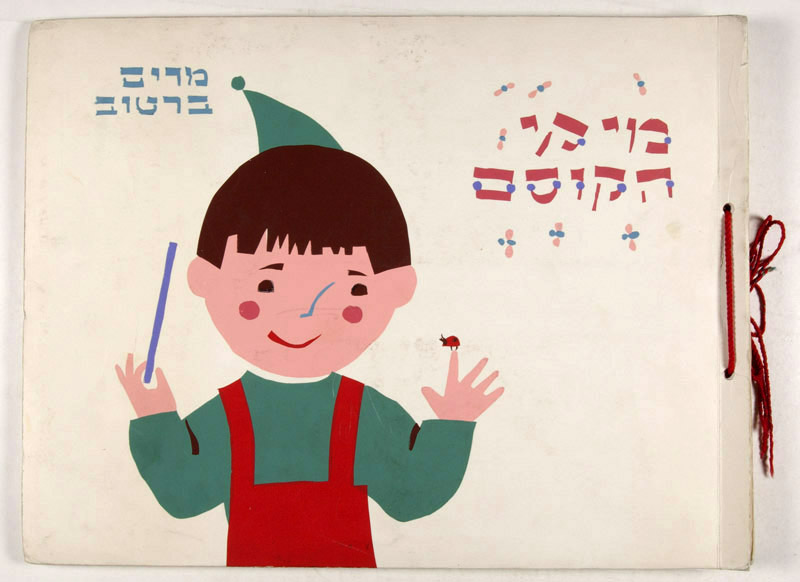
This is a hand made illustrated picture book by Israeli artist Miriam Bartov, written in the early 1980s. It tells of a little boy named Mickey who discovers a wand and proceeds to abuse it with expected and comic results. Mickey starts off by making various things bigger and giving himself wings. His attempt at flight does not work out so well and he falls onto one of his recently created giant flowers.

Before much longer he is on the run from one of his giant frogs.

With the book we have a letter in German from Bartov to a Mr. Bergmann of the Bundesverlag in Mainz, pitching the book to the publishing company.
Apparently Mickey the Magician was never published. One suspects that it might have something to do with it being too similar to another Mickey the Magician.
Apparently Mickey the Magician was never published. One suspects that it might have something to do with it being too similar to another Mickey the Magician.
As far as we can tell, there are two copies of this book in existence, our copy and one in the Staatsbibliothek in Berlin.
Monday, September 12, 2011
The Exodus from Egypt and Modern Revolutions
Judah David Eisenstein was an unheralded pioneer in the field of American Judaica publishing. Working in the early twentieth century, he edited and published numerous collections of Hebrew source material such as Midrash and Jewish polemics anti-Christian polemics. His work remains useful if you can get your hands on it. Here is a piece from the introduction to his Haggadah. Eisenstein follows a common Jewish apologetic troupe troupe from the period, Judaism and democracy. The idea being that Judaism is not only compatible with American style democracy, but was the source for it. In the service of this cause, Eisenstein is even willing to put in a good word about the Puritans. The Haggadah first came out in 1920 so the Russian Revolution also is mentioned.

The exodus of Israel from Egypt is the greatest event in history of Israel and also in the history of the entire world. The children of Abraham Isaac and Jacob were the first to teach the dwellers of the world that it was possible for men enslaved under harsh masters to throw off from them their yoke and leave for freedom. And from them others learned to do likewise. The story of the exodus from Egypt was studied by the enlightened pure people living in America (Puritans) and it came into their hands to rebel against the rule of England in the year 1776 and proclaim freedom to all those living in the United States. And this thought inspired the French in their rebellion against their harsh rulers in the year 1789. And from them evolved the rebellion in Russia against the oppressive Czar and his regime that had already decayed in the year 1917. Just that the idea of freedom and the spirit of freedom never came to the rebels in a straight path rather in a crooked manner. But there is no doubt that the first source to rebel flowed from the Israelites leaving Egypt. (Ozar Perushim we-Ziyurim el Hagada Shel Pesah pg. iv.)
Sunday, September 11, 2011
An Original Handwritten Letter from Victor Hugo
Every once in awhile one comes across a truly unexpected treasure. At Kline Books we recently came into possession of the complete works of Victor Hugo (1802-85) in English printed in the nineteenth century. One of the volumes contained a letter from none other than the author himself, written in 1864 to an American named Charles Havens Hunts. At this point in Hugo's life he had been in exile from France since 1851 when Napoleon III declared himself emperor. Hugo lived on the island of Guernsey in the English Channel where he took up residence in the Hauteville House. Hunts had recently written a biography of Senator Edward Livingston (1764-1836), an American political reformer and advocate of prison reform. Victor Hugo wrote to Livingston as a young man in 1834, when the latter was serving as the United States minister to France, praising him for his humanitarian efforts. Hunts included this letter in his book and sent Hugo a copy. Hugo is writing back to express his thanks and his admiration for both Livingston and Hunts.

Hauteville House - 15 Mars 1864. Monsieur, precisely 30 years ago, in March 1834, I sent the letter you have mentioned in your remarkable book to Senator Livingston. Today, I stand closer to him and you. It is called "Law of Progress." The honest and sincere men that walked before them, often coming from opposing factions, always end up united. You too, are sending me an excellent book. This is the work of a noble and serious mind. I wish you all my best for the appeasement and enlargement of your illustrious republic. It will triumph for liberty. Acknowledge the expression of my sincere cordiality.
Victor Hugo
Monsieur Ch. Havens Hunts, author of the Life of Edward Livingston.
Letters like the ones written to Livingston and Hunts should give one pause from thinking of Hugo simply as a French writer. Much of Hugo's work, including Les Miserables (1862) was written in exile in English territory. Furthermore Hugo's interest in humanitarian causes led him to take an interest in the United States and form friendships with Americans.
Yiddish Edition of Charles Darwin's Descent of Man

We have here a Yiddish translation, done by Y. A. Merison, of Charles Darwin's 1871 follow up to Origin of Species, The Descent of Man, and Selection in Relation to Sex. It was published in 1921 in New York by Max N. Maisel (1872-1959), who ran a publishing company, The Grand Street Press of Literature and Knowledge, devoted to printing and disseminating scientific literature in Yiddish. Organizations like Maisel's are a side of Yiddish culture that is very easy to overlook today when Yiddish is almost the sole dominion of the Ultra-Orthodox. There was a time when Yiddish was a powerful secularizing force.
Merison also wrote a childcare guide titled Muter un kind (1912) What does Darwin have to do with parenting? Well the Grand Street Press also distributed birth control literature by Margaret Sanger and Ben Zion Liber so clearly there was a connection in Maisel's mind. Now it makes sense to me to, if you are a good Darwinist, hand out birth control literature to immigrants to keep their population in check. But why would you then turn around and let them in on the plan?
To the best of my knowledge, Darwin did not get the company into trouble but the birth control literature did run afoul the obscenity laws in force at the time. I guess the tactic of saying things in Yiddish as a way of dodging gentile censors, so beloved by later generations of Jewish comedians, did not cover contraceptives.
Presumably our secularizing immigrant Jew would also desire to learn English and would soon be able to read Darwin in the original. Thus one assumes this is for people fresh off the boat. Why would someone think that new immigrants, with all of their concerns in adapting to a new country, first and foremost of them being to learn English, needed to make their way through Darwin. I could understand translating Israel Zangwill's play The Melting Pot or Uncle Tom's Cabin (this book actually helped by great-grandfather learn English as an immigrant) to teach people about American culture, but a scientific treatise that few English speakers ever read?
One can only imagine:
Dear Ma,
I have successfully reached the United States and am adapting very well to my new environment. Not to worry, I am using protection. I have my copy of Darwin's Descent of Man. Yes it is in the Mama-lashon. And I have some Margaret Singer (Sanger, Singer what's the difference) as well. So not to worry about grandchildren; I have that all under control.
Your beloved yingilah,
Chaim Dovid Horowtiz (soon to be Harvey Drew Howard)
Tuesday, September 6, 2011
Moses Mendelssohn and the Rabbi David Frankel Sermon
In regards to my previous post on Rabbi David Frankel's sermon of thanksgiving after the Prussian victory at Leuthen, S. kindly pointed out that the sermon was likely the product of Frankel's famous student Moses Mendelssohn.
I managed to track this to Alexander Altmann's biography of Mendelssohn. Here is the relevant passages:
No account of Mendelssohn's exercises in ars poetica would be complete without some mention of his synagogal hymns and sermons. The young bel esprit was by no means averse to putting his talents at the service of the Berlin community. The chance to do so was provided by the Seven Years' War. When Austria and Saxony opened hostilities against Prussia toward the end of 1756, the Jews of Berlin added to their daily prayers the recital of certain appropriate psalms and a special prayer composed in Hebrew by Hartog Leo and translated into German by Mendelssohn. Frederick II's surprising victory at Rossbach caused great jubilation and was celebrated by a thanksgiving service in the synagogue on November 12, 1757. Mendelssohn, again, translated a Hebrew text, a hymn written by Hartog Leo, into German. It was published by the community, and it seems that it has also been planned to publish Mendelssohn's German version of a sermon preached by Chief Rabbi Frankel. Another great victory, at Leuthen, was duly celebrated on December 10. 1757. The same pattern was repeated, but this time both the hymn and the sermon were published in German. According to the title page, the sermon had been "delivered" by Frankel and then "translated into German" (omitting Mendelssohn's name). In fact, however, Mendelssohn had written the sermon, as he remarked in a letter to Lessing that, on internal evidence, can be dated about December 15, 1757: "I shall no longer swear to anything in the world after it has come to pass that I write a sermon and praise a king. I also translated some Hebrew thanksgiving hymns into German, and these are printed." This sermon, which is the one praised in Lessing's letter of December, 1757, is the earliest known specimen of modern Jewish preaching in the German tongue. It has a slightly philosophical flavor and reflects the spirit of the Enlightenment. (Moses Mendelssohn: A Biographical Study pg. 67-68.)
So Mendelssohn authored the sermon and translated it into German. This still leaves the question of who translated the sermon into English and how did it come to be published in London and in New York?
I managed to track this to Alexander Altmann's biography of Mendelssohn. Here is the relevant passages:
No account of Mendelssohn's exercises in ars poetica would be complete without some mention of his synagogal hymns and sermons. The young bel esprit was by no means averse to putting his talents at the service of the Berlin community. The chance to do so was provided by the Seven Years' War. When Austria and Saxony opened hostilities against Prussia toward the end of 1756, the Jews of Berlin added to their daily prayers the recital of certain appropriate psalms and a special prayer composed in Hebrew by Hartog Leo and translated into German by Mendelssohn. Frederick II's surprising victory at Rossbach caused great jubilation and was celebrated by a thanksgiving service in the synagogue on November 12, 1757. Mendelssohn, again, translated a Hebrew text, a hymn written by Hartog Leo, into German. It was published by the community, and it seems that it has also been planned to publish Mendelssohn's German version of a sermon preached by Chief Rabbi Frankel. Another great victory, at Leuthen, was duly celebrated on December 10. 1757. The same pattern was repeated, but this time both the hymn and the sermon were published in German. According to the title page, the sermon had been "delivered" by Frankel and then "translated into German" (omitting Mendelssohn's name). In fact, however, Mendelssohn had written the sermon, as he remarked in a letter to Lessing that, on internal evidence, can be dated about December 15, 1757: "I shall no longer swear to anything in the world after it has come to pass that I write a sermon and praise a king. I also translated some Hebrew thanksgiving hymns into German, and these are printed." This sermon, which is the one praised in Lessing's letter of December, 1757, is the earliest known specimen of modern Jewish preaching in the German tongue. It has a slightly philosophical flavor and reflects the spirit of the Enlightenment. (Moses Mendelssohn: A Biographical Study pg. 67-68.)
So Mendelssohn authored the sermon and translated it into German. This still leaves the question of who translated the sermon into English and how did it come to be published in London and in New York?
Subscribe to:
Posts (Atom)